-
English (US)
Choose your country or region:
Europe
Asia - Australasia
Middle East - Africa
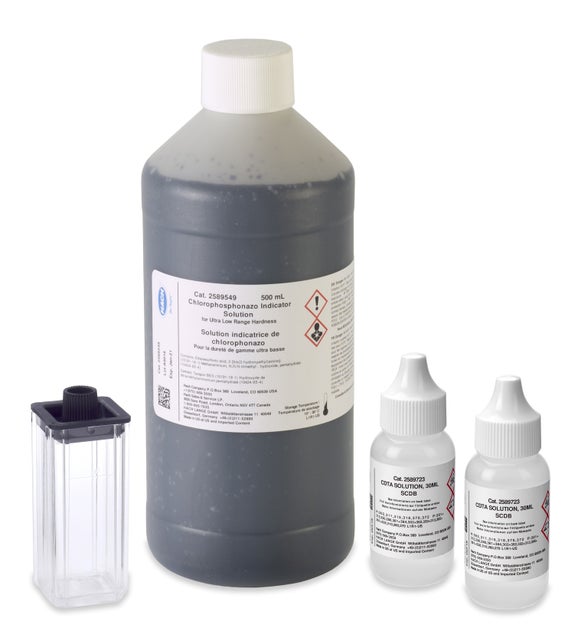
Product Number: 2603101
Ultra-Low Range Total Hardness Testing for High-Purity Water
The Hardness (ULR) Reagent Set, Bulk Solution (2603101) is designed for Ultra-Low Range measurement of Calcium and Magnesium Hardness in high-purity water applications using the Chlorophosphonazo colorimetric method (Hach Method 8374 DOC316.53.01044 or DOC316.53.01045).
This reagent set enables accurate determination of total hardness as CaCO₃ at concentrations far below traditional titration methods.
The bulk liquid format is optimized for use with the Hach Pour-Thru Cell, supporting high-volume testing with improved precision and workflow efficiency. It can also be used with a standard plastic cell.
Key Features & Benefits
Ultra-Low Range Hardness Detection
Measures total hardness from:
• 4 - 1000 µg/L total Hardness as CaCO₃ using a Pour-Thru Cell
• 8 - 1000 µg/L Total hardness as CaCO₃ using a standard plastic cell
Ideal for High-Purity Water Applications
Designed for monitoring trace hardness in:
• Municipal pretreatment
• Membrane protection
• Groundwater and source water monitoring
• Reverse osmosis (RO) systems
• Demineralizer trains
• High-pressure boiler systems
• Semiconductor and ultrapure water processes
• Zeolite water softening system
• Pharmaceutical (makeup water)
Typical Applications
• Municipal pretreatment
• Membrane protection
• Groundwater and source water monitoring
• Reverse osmosis (RO) systems
• Demineralizer trains
• High-pressure boiler systems
• Semiconductor and ultrapure water processes
This rapid liquid method utilizes liquid reagents, bottle top dispensers (Ordered separately as item number 2563137) and pour-thru cells (item number LZV899) to provide simplified, ultra-low level testing.
Since the pour-thru cell provides a stationary optical system, Rapid Liquid methods typically provide better precision than methods that require movement of sample cells.
Rapid Liquid methods are ideal for high-volume testing.